
We may earn a commission when you buy through links on this site, at no extra cost to you. As an Amazon Associate I earn from qualifying purchases. Read our affiliate disclosure.
Short answer
For a portable jump pack, our pick is the WOLFBOX MegaVolt24, the best overall in our jump starter guide. See the WOLFBOX MegaVolt24 at Amazon (choose the MegaVolt24 / 4000A version).
Car dead on a cold morning? This guide shows how to jump start a car in cold weather, and why it happens. You’re not imagining the pattern. AAA’s Automotive Research Center says a battery “loses about 35 percent of its strength” at 32°F and “about 60 percent” at 0°F, while starting the engine “may need up to twice the amount of current.” A battery that was fine on a mild evening can’t turn the engine over at dawn.
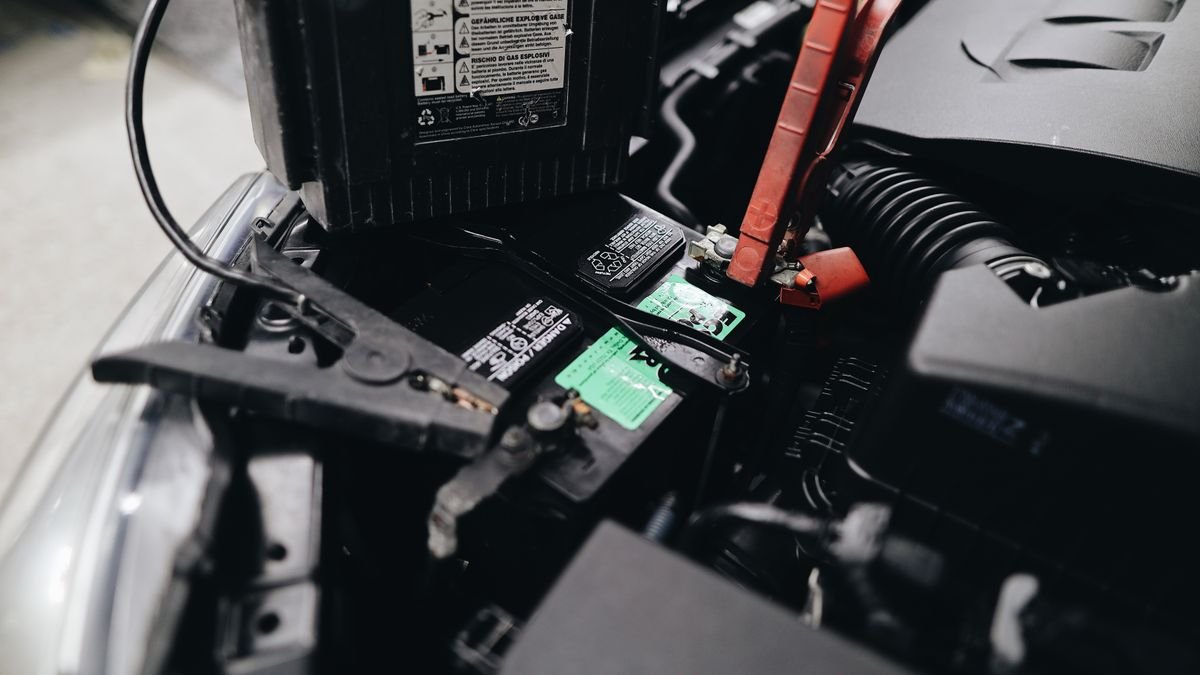
The short answer: here’s how to jump start a car in cold weather. With a portable jump pack: red clamp on positive, black clamp on negative or bare metal, switch the pack on, and start. With jumper cables and a second car: connect in the exact order below, and put the last black clamp on a ground point on the dead car, not on the dead battery. Never try to jump a frozen battery. A portable jump starter kept in the warm cabin is the easiest fix, and our pick is the WOLFBOX MegaVolt24.
The steps below come from NOCO’s GB40 user guide, GOOLOO’s jump-starting tutorial and Chevrolet’s 2019 Impala owner’s manual. Your own owner’s manual comes first, especially if your car has remote jump-start terminals under the hood.
Jump to: Safety checks · Using a jump starter · Using jumper cables · A jump starter to keep · FAQ
Before you start: safety checks
- Read your car’s jump-start section. Many cars have remote jump terminals under the hood; use them if your manual says so.
- Check the battery type. NOCO’s GB40 guide says it’s “for jump starting 12-volt lead-acid batteries only.”
- Never jump a frozen or damaged battery. NOCO: “Do not jump start a frozen battery.”
- Wear eye protection, keep sparks and flames away, and make sure there’s ventilation. Chevrolet warns that batteries contain acid and explosive gas.
- Keep clear of the cooling fan. Chevrolet says it “can start up even when the engine is not running.”
- Don’t clamp to the carburetor, fuel lines or thin sheet metal (NOCO).
How to use a jump starter to jump start a car in cold weather
- Turn off the loads: headlights, radio and A/C (NOCO). GOOLOO also says to keep the pack switched off while you connect it.
- Red clamp to the positive (+) terminal.
- Black clamp to the negative (–) terminal or the chassis (NOCO). GOOLOO says “a solid, unpainted metal part of the engine block or chassis,” and notes that many smart packs recommend the negative terminal. Follow your pack’s manual.
- Switch the pack on. On the NOCO GB40, a white Boost light means it’s ready, and a red Error light means the clamps are reversed.
- Start the car. NOCO says, “Most vehicles will immediately start. Some… may require the GB40 to be connected for up to 30 seconds.” If it doesn’t start, wait 20 to 30 seconds and try again.
- Don’t overdo it. NOCO: “Do not attempt more than five (5) consecutive jump starts within a fifteen (15) minute period.” Then let the pack rest for 15 minutes.
- Disconnect in reverse order, negative clamp first (NOCO).
Pack won’t detect the battery? The GB40 works on batteries down to 2 volts. Below that, its Manual Override forces power on, but NOCO warns it “disables all safety measures,” including spark-proof and reverse-polarity protection. “Use this mode with extreme care.”
How to jump start a car with jumper cables
These steps are from Chevrolet’s 2019 Impala owner’s manual (“Jump Starting – North America”). Check your own manual for your car’s terminals.
- Check the other car has a 12-volt, negative-ground system.
- Park the cars close, but not touching. Set both parking brakes, and put an automatic in Park (a manual in Neutral).
- Turn both ignitions off and switch off lights and accessories on both cars. Hazard lights are OK if you need them.
- Red (+) cable: connect one end to the dead car’s positive terminal (or remote jump terminal), then the other end to the good battery’s positive terminal. “Do not let the other end… touch metal.”
- Black (–) cable: connect one end to the good battery’s negative terminal.
- Last connection: the other black end goes to a ground point on the dead car. Chevrolet: “The other end of the negative (–) cable does not go to the dead battery.” On the Impala, that’s a remote grounding post.
- Start the good car and “run the engine at idle speed for at least four minutes.”
- Try to start the dead car. “If it will not start after a few tries, it probably needs service.”
- Remove the cables in exactly the reverse order. Then let the jumped car idle “for several minutes.”
Chevrolet warns that connecting or removing the cables in the wrong order can cause “electrical shorting” and damage. You’ll also see advice online to rev the donor car or drive for a set time afterward. We follow the manual’s idle instructions instead.
Cold-weather tips for your jump pack
- Keep the pack warm. GOOLOO says to “keep your jump starter indoors or in the warm cabin,” and warns, “If the jump starter itself is frozen, it may fail to provide the necessary ‘crank.'”
- Know its temperature range. The NOCO GB40 is rated to operate from -4°F to 122°F (-20°C to 50°C).
- A cold pack may not work at all. When Consumer Reports cooled both the car and the jump starter to 0°F, none of the packs could start a weak battery (Consumer Reports, archived guide).
- Recharge it every 3 to 6 months, even if you haven’t used it (GOOLOO).
After the jump
Have the battery and charging system tested, especially if the battery is more than three years old. AAA puts average battery life at “three to five years,” and says it may be “closer to three years” in cars with more electronics. A battery that died once in the cold is likely to do it again.
We may earn a commission when you buy through links on this site, at no extra cost to you. As an Amazon Associate I earn from qualifying purchases. Read our affiliate disclosure.
The jump starter to keep in your car
Our pick: the WOLFBOX MegaVolt24, the best overall in our jump starter guide. TechGearLab and WIRED both named it best overall in 2026, and in TechGearLab’s test it started a V6 with a completely dead battery three times in a row. On Amazon, choose the MegaVolt24 / 4000A version on the page.
Where to buy: Check price at Amazon · Check price at WOLFBOX
- Best value: the GOOLOO GT4000S, CNN Underscored’s top pick after a real load test.
Where to buy: Check price at Amazon · Check price at GOOLOO
- Budget pick: the GOOLOO GP2000, TechGearLab’s Best Bang for the Buck, for cars and crossovers rather than big trucks. Check the current price at Amazon.
- Most compact: the NOCO GB40, Car and Driver’s Most Compact and TechGearLab’s Best Compact Model (CNN Underscored calls it its best budget jump starter), best for 4- and 6-cylinder cars. One owner on r/VEDC says a GB40 ran out of charge after three tries on a Subaru Forester at 2°F (one owner’s report, unconfirmed).
Where to buy: Check price at Amazon · Check price at Walmart · Check price at AutoZone
- Cold-climate option (untested): the GOOLOO GT4000 Arctic has a built-in battery preheat rated to -40°F, per its listing, but we found no independent test of it. Check the current price at Amazon.
Full specs, test results and known complaints are in our best jump starters guide. Torn between NOCO’s compact packs? See NOCO GB40 vs GBX55. Confused by the amp numbers on the box? Read peak amps vs cranking amps.
How we built this guide
We did not test these methods or packs ourselves. Mike re-checked every quote on November 17, 2026, against NOCO’s GB40 user guide, GOOLOO’s tutorial, Chevrolet’s 2019 Impala owner’s manual and AAA Oregon/Idaho’s battery page. The product picks match our jump starter guide, which relies on TechGearLab, WIRED, CNN Underscored and other independent tests. We checked every linked product’s Amazon page on November 17, 2026.
More in this topic: Safety and emergency start-here guide.
For our full process, see how we choose the gear we recommend.
FAQ
Why is my car battery dead on cold mornings?
Cold weakens the battery and makes the engine harder to turn. AAA says a battery loses about 35% of its strength at 32°F and about 60% at 0°F, while starting can need up to twice the current.
Which jumper cable goes on first?
With cables, per Chevrolet: red to the dead car’s positive, red to the good battery’s positive, black to the good battery’s negative, and last, black to a ground point on the dead car, not the dead battery. With a jump pack, per NOCO: red to positive, then black to negative or the chassis.
Can you jump-start a frozen battery?
No. NOCO’s guide says, “Do not jump start a frozen battery.” Get it checked or replaced.
Why won’t my jump starter work in the cold?
The pack itself may be too cold. When Consumer Reports cooled both the car and the pack to 0°F, no pack could start a weak battery (archived guide), and GOOLOO warns a frozen pack may fail to crank. Keep it in the warm cabin or indoors, and keep it charged.
How long should I wait after a jump-start?
With cables, Chevrolet says to let the jumped car idle “for several minutes” after you remove them. Then have the battery and charging system tested.
Should I keep a jump starter in my car in winter?
Keep it with you, in the warm cabin, rather than in a freezing trunk overnight, and bring it indoors on the coldest nights. GOOLOO also recommends recharging it every 3 to 6 months.
My car clicks but won’t start on a cold morning. Is it the battery?
It may be. Cold weakens batteries, as AAA’s figures show, so try a jump-start. If it won’t start “after a few tries, it probably needs service,” per Chevrolet.

Mike is the byline for The Car Gear Guide’s research team. We read independent tests, maker specs and fit guides, then turn them into plain-English buying guides for US drivers. We don’t hand-test the products we recommend. Guides are researched and drafted with AI tools, then fact-checked and edited before they go up.